
On this page
- What is the All-on-4 treatment concept?
- How does the four-implant approach work?
- Who is a candidate for All-on-4?
- What happens on treatment day and afterward?
- What is recovery like after All-on-4 treatment?
- What are the downsides and limits of All-on-4?
- What affects the cost of All-on-4 treatment?
- Care at Perio One
- When to call us
- What to expect
- Common questions
At a glance
- The All-on-4 concept uses four implants, angling the two back ones, to support a full arch of fixed teeth.
- When the implants are stable enough, a temporary bridge can be attached the same day as surgery.
- The angled back implants often make use of bone that is already there, sometimes without a sinus lift.
- Not everyone qualifies for four implants or for same-day teeth; a staged plan is the fallback when stability isn't there yet.
- The final bridge follows months later, once the bone has fully healed around the implants.
What is the All-on-4 treatment concept?
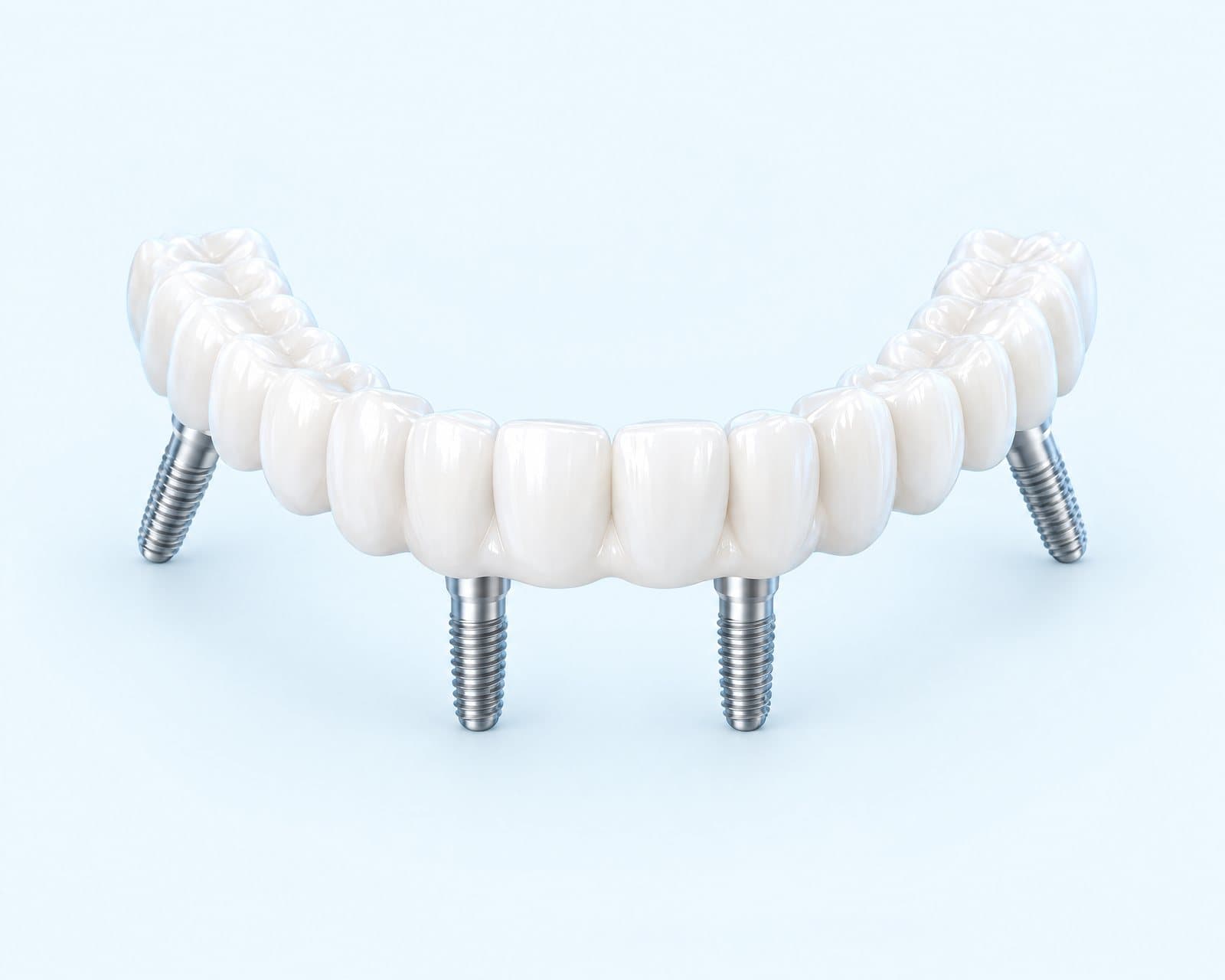
The All-on-4 treatment concept replaces a full arch of failing or missing teeth with four implants and a fixed bridge. Two implants go in toward the front of the jaw, and two go in further back at an angle. Together, the four support a full row of replacement teeth.
The idea behind using only four implants is to spread support across the arch while working with the bone that is naturally there. It is one of several full arch dental implants approaches, chosen when the bone and bite suit it.
How does the four-implant approach work?
The two back implants are placed at an angle rather than straight up and down. Angling them lets each implant reach further into available bone, often toward the front of the jaw, without leaning into the sinus above or a nerve below. This can mean available bone is used without a sinus lift, when there is enough of it.
A cone beam CT scan guides exactly where each implant goes, since the angle and depth both matter. Once placed, the four implants are joined by a bridge that supports the replacement teeth, spreading the biting forces across all four.
Who is a candidate for All-on-4?
Good candidates have failing or missing teeth across most of an arch and enough bone, even if thin, to anchor four angled implants. Gums free of active infection and reasonable control of conditions like diabetes also matter, since they affect healing. A 3D scan and exam show whether the concept fits your jaw.
Some people are better suited to a plan with more implants or a graft first, especially when bone is very thin or the sinus sits low enough to limit the angle. Heavy grinding or clenching is discussed too, since it adds force to the implants.
What happens on treatment day and afterward?
On treatment day, any remaining teeth in the arch are removed if needed, and the four implants are placed under local anesthetic. When the implants are firm enough, same day dental implants let you leave with a temporary bridge that same day. Otherwise, a temporary denture is worn while the bone heals.
Over the following months, the bone bonds to the implants. You return for follow-up visits to check healing, and the final fixed bridge is made once the implants are ready to carry it.
What is recovery like after All-on-4 treatment?
Swelling, bruising and soreness are common for the first several days, and a soft diet is usual for some weeks while the implants heal. Most people manage the early days with rest and the guidance given after surgery. Numbness from the anesthetic fades within hours.
If you left with temporary teeth, you chew carefully at first and build up to firmer foods as healing allows. A follow-up visit checks the implants and the fit of the temporary bridge.
What are the downsides and limits of All-on-4?
All-on-4 is a well-studied concept, but it has real limits. Not everyone is stable enough on the day for a temporary bridge, and some people need a staged plan instead. Speech and the feel of the tongue against the bridge can take time to adjust to.
Like any implant surgery, it can bring infection, an implant that doesn't bond, or, in the lower jaw, nerve numbness that is usually temporary but not always. Because only four implants carry the whole arch, a problem with one implant affects the plan more than it would with more implants spread out. Peri-implant disease, an infection around an implant, remains a risk if plaque isn't controlled, and the bridge or a screw can eventually need repair.
What affects the cost of All-on-4 treatment?
Cost depends on whether temporary teeth are placed the same day, the materials used for the final bridge, and how much imaging and planning the case needs. A straightforward case with adequate bone often costs less than one needing extra grafting. Your exam sets the estimate for your mouth.
- Whether temporary teeth are placed the same day or after healing
- The materials used for the temporary and final bridge
- Imaging and planning, including a 3D scan
- Whether any additional bone work is needed
- Future upkeep, including repairs and eventual replacement of the bridge
Care at Perio One
At Perio One, an All-on-4 evaluation starts with an examination and a 3D cone beam CT scan of your bone and bite. Dr. Randal Comeaux, DDS, Diplomate of the American Board of Periodontology, reviews the images with you before recommending a plan.
Dr. Comeaux explains whether four implants suit your jaw, or whether a different full-arch approach fits better, in plain language you can act on.
We coordinate with your general dentist, who typically designs the final bridge, and referrals from Lafayette-area dentists are welcome. Once your teeth are in place, our periodontal maintenance program helps protect the implants.
When to call us
- Most teeth in an arch are failing
- A denture you cannot wear
- Fixed teeth that feel loose, cracked or sore
- After your implants go in: a fever, swelling that is spreading or getting worse, or bleeding that won't stop under firm pressure. Phone us right away, and go to an emergency room or call 911 if it's severe or you can't swallow or breathe easily.
Our periodontists, Dr. Randal Comeaux and Dr. Lauren Langlois, can talk through what you’re noticing.
Call to scheduleWhat to expect
- Examination and imaging
We check your teeth, gums, bite and bone, and take a 3D scan to plan the implant angles.
- Implant placement
The four implants are placed under local anesthetic, two straight and two angled toward the back of the jaw.
- Same-day teeth, if stable
When the implants are firm enough, a temporary bridge is attached before you leave; otherwise a temporary denture is worn.
- Healing
The bone bonds to the implants over the following months while you eat a soft diet.
- The final bridge
Once healing is confirmed, your dentist fits the final fixed bridge onto the four implants.
Common questions
Who is a good candidate for All-on-4 dental implants?
People with failing or missing teeth across most of an arch, and enough bone, even if thin, to anchor four angled implants. A 3D scan and exam confirm whether the concept fits your jaw, or whether another approach suits you better.
What are the disadvantages of All-on-4?
Not everyone is stable enough for temporary teeth the same day, and a problem with one of the four implants affects the whole bridge more than it would with more implants. Speech and tongue feel can take time to adjust to, and the bridge can eventually need repair.
How long does All-on-4 last?
The implants often last many years with good care and regular maintenance. The bridge and any attachment screws can need repair or replacement over time, so plan on ongoing upkeep rather than a one-time fix.
Can All-on-4 implants become loose?
An individual implant can, rarely, fail to stay firmly anchored, and a screw holding the bridge can loosen over time. Either needs prompt attention, since loose components put extra force on the rest of the bridge.
Is All-on-4 painful?
The implants are placed under local anesthetic, so the procedure itself should not hurt. Afterward, expect swelling and soreness for several days, similar to other implant surgery, which usually settles with rest and a soft diet.
Sources
- Cleveland Clinic: Implant-supported dentures
- American Academy of Periodontology: Dental implant procedures
This page is general education, not a diagnosis. Your periodontist will recommend care after an examination.