
On this page
At a glance
- PRF comes from a small draw of your own blood, with no other substances added.
- It differs from PRP mainly in how it is processed and the form it takes once it is ready to use.
- It is placed alongside grafts, sockets, sinus lifts, and gum grafts, not used on its own.
- Research suggests it may help soft-tissue healing and comfort in some cases; a bone-healing benefit is less consistent across studies.
- It takes only a few extra minutes at the start of a procedure you were already having.
Your gum graft, step by step
30 seconds, with sound and captions. Illustration only.
What is platelet-rich fibrin?
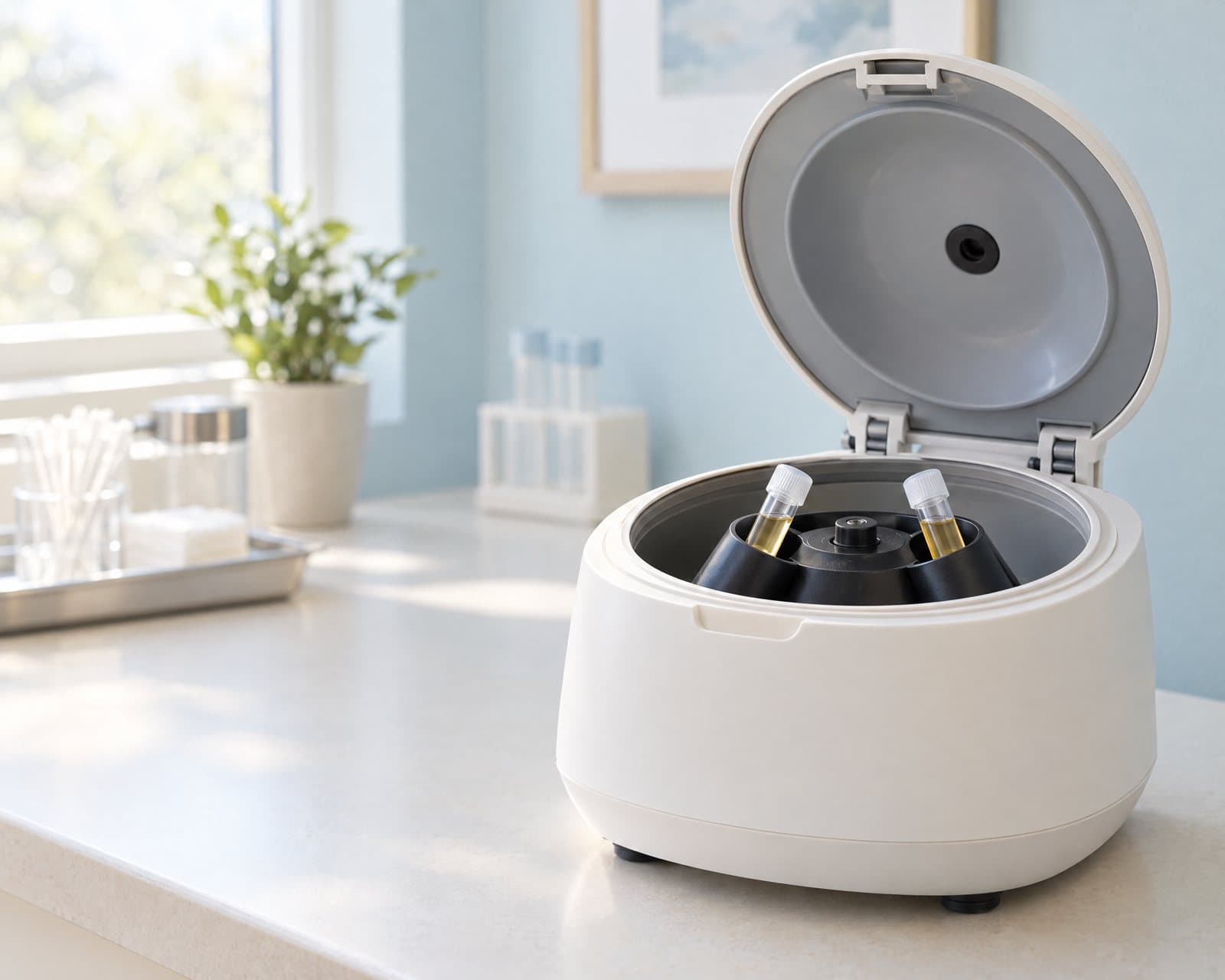
Platelet-rich fibrin, or PRF, is a concentrate made only from your own blood. A small sample is drawn, then spun in a centrifuge, which separates out platelets, white blood cells, and fibrin, the protein that forms a gel-like matrix.
No other substances are added during the process. The result is a soft, natural clot, made entirely from your own blood, that can be placed directly into a healing site.
It is used to support healing after certain periodontal and implant procedures, rather than as a treatment on its own.
How is PRF made from your own blood?
Making PRF starts with a blood draw, similar in size to a routine lab test, taken right before or during your procedure. The tube is then spun in a centrifuge for several minutes.
Spinning separates the blood into layers by weight, and the middle layer, rich in platelets and fibrin, is collected. It naturally forms into a soft membrane or plug as it sits.
Because it comes from your own blood, with no donor material involved, the risk of a reaction is very low.
Where is PRF used in dental care?
PRF is placed alongside several periodontal and implant procedures, mixed with graft material or laid directly over a healing site.
It is sometimes mixed with a dental bone graft, placed in a socket during bone graft after tooth extraction, or used to support a gum graft.
It is also used alongside periodontal regeneration, the procedure that rebuilds bone and attachment around a natural tooth, and in sinus lift procedures for the upper back jaw.
How is PRF different from PRP?
PRF and platelet-rich plasma, or PRP, are related concentrates made from your own blood, but they are prepared differently and used in different forms.
PRP is processed with an anticoagulant and sometimes an activating substance, and it stays liquid, often injected. PRF is spun without those additives and naturally sets into a solid, gel-like membrane that can be placed directly into a healing site.
Because PRF has no added substances, some clinicians prefer it for procedures where a solid membrane is useful, such as covering a graft or a socket.
| What differs | PRF | PRP |
|---|---|---|
| How it is made | Spun once, without added substances | Processed with an anticoagulant and sometimes an activator |
| Added substances | None | An anticoagulant, and sometimes an activating substance |
| Form | A solid, gel-like membrane | A liquid, often injected |
| Common dental uses | Covering grafts, sockets and gum grafts | Less common in dental settings than in some medical uses |
Is PRF safe, and what does research show?
PRF is generally considered safe, since it comes only from your own blood with nothing added. The blood draw itself carries the small, familiar risks of any lab draw, such as minor bruising.
Research on PRF's benefits is mixed. Some studies suggest it may help soft-tissue healing and comfort after certain procedures, while its effect on bone healing is less consistent from study to study. It is reasonable to view it as a possible extra rather than a sure boost.
Tell us if you have a bleeding disorder or take a blood-thinning medicine, since these can affect how the blood draw and the resulting PRF behave.
What is a PRF visit like?
A PRF visit adds only a few minutes to a procedure you are already having. A small blood draw happens early on, and the sample spins in the centrifuge while other preparation continues.
By the time it is needed, the PRF is ready to place, whether that means laying it over a graft, tucking it into a socket, or supporting a gum graft site.
You won't notice much difference in the appointment overall, aside from the extra draw at the start.
Aftercare follows the procedure PRF was part of. Call us right away if a fever, spreading or worsening swelling, or bleeding that firm pressure won't stop shows up afterward. With severe symptoms, or trouble breathing or swallowing, go to an emergency room or call 911.
What affects the cost of PRF?
PRF adds a modest cost to the procedure it supports, since it uses your own blood rather than a purchased material. Whether it is recommended, and its cost, depends on the procedure itself.
- Which procedure PRF is being added to
- Whether one or more tubes of blood are processed
- The cost of the underlying procedure itself
- What your dental plan covers
Care at Perio One
At Perio One in Lafayette, Dr. Randal Comeaux, DDS, Diplomate of the American Board of Periodontology, discusses whether PRF fits your procedure and what the current research does and doesn't show.
PRF is offered as an addition to certain grafts and gum procedures here, not as a stand-alone treatment. We explain the reasoning in plain language before any blood is drawn.
We coordinate with your general dentist on your overall plan, and referrals are welcome.
Common questions
What is PRF in dentistry?
PRF, or platelet-rich fibrin, is a concentrate made from a small sample of your own blood, used to support healing alongside certain gum and bone procedures.
Is PRF worth it?
It depends on the procedure and your priorities. Research suggests it may help soft-tissue healing and comfort in some cases, though the evidence for a bone-healing benefit is mixed. It is reasonable to see it as a possible extra rather than a must-have.
Does PRF prevent dry socket?
Some studies suggest PRF may lower the chance of dry socket after certain extractions, though results are not consistent across all studies. It is one possible extra, not a sure outcome.
How is PRF made?
A small sample of your own blood is drawn and spun in a centrifuge, which separates out platelets and fibrin without adding any other substances. It naturally sets into a solid, gel-like material ready to use.
Is PRF better than PRP?
Neither is simply better; they are prepared differently and suit different uses. PRF sets into a solid membrane with no added substances, while PRP stays liquid and is processed with an anticoagulant.
Can everyone have PRF?
Most people can, since it comes from their own blood. Tell us about any bleeding disorder or blood-thinning medicine beforehand, since these can affect the blood draw and how the PRF forms.
Sources
- Cleveland Clinic: Dental bone graft
- American Academy of Periodontology: Surgical procedures
- Cleveland Clinic: Platelet-rich plasma
This page is general education, not a diagnosis. Your periodontist will recommend care after an examination.