
On this page
- Watch the video
- What is the difference between an implant and a bridge?
- How do an implant and a bridge compare?
- Which is right for your situation?
- What does each treatment involve?
- What is recovery like with each?
- What are the risks of an implant or a bridge?
- What affects the cost of an implant or a bridge?
- Care at Perio One
- When to call us
- What to expect
- Common questions
At a glance
- A bridge avoids surgery and is usually finished within a few weeks.
- An implant leaves the neighboring teeth untouched and helps keep bone in the gap.
- An implant takes several months, and some people need a bone graft first.
- A bridge needs daily cleaning under the false tooth; an implant is cleaned much like a natural tooth.
- Either one lasts longer with healthy gums, daily cleaning and regular checkups.
Your dental implant, step by step
30 seconds, with sound and captions. Illustration only.
What is the difference between an implant and a bridge?
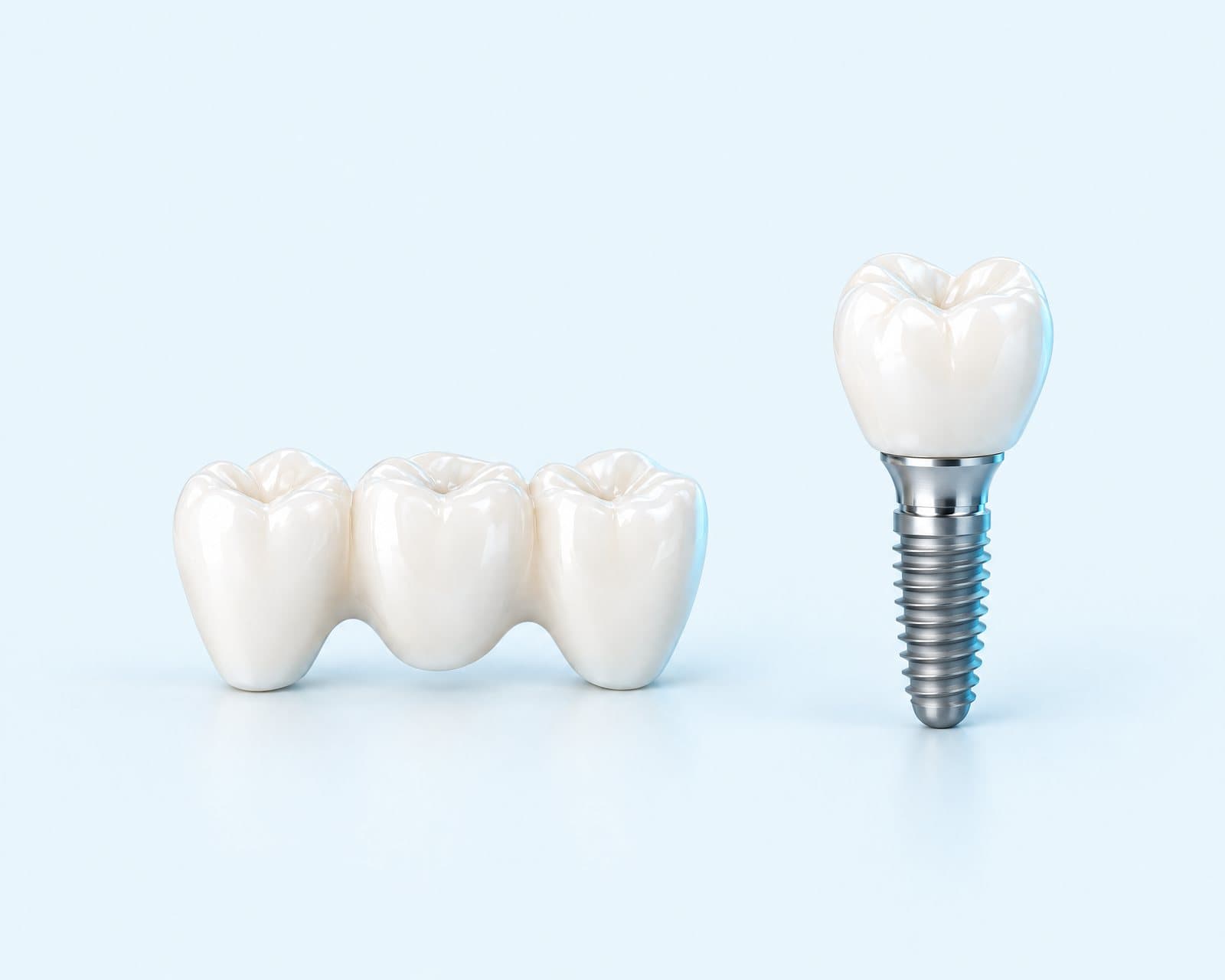
A dental implant is a small post, usually titanium, placed in the jawbone where the tooth root used to be. Once the bone heals around it, a crown is attached on top. A traditional bridge is a false tooth held by crowns on the teeth beside the gap, which are reshaped to fit them.
The key difference is support: an implant stands on its own in the bone, while a bridge leans on its neighbors.
Other bridge designs exist. A resin-bonded bridge attaches with small wings bonded to the backs of the neighboring teeth, so it needs less reshaping. A cantilever bridge anchors on one side only. Removable options such as a partial denture or a flipper can also fill a gap, and one often serves as a temporary tooth while an implant heals.
How do an implant and a bridge compare?
Each has real advantages. A bridge is faster and involves no surgery. An implant spares the neighboring teeth, helps preserve the bone under the gap and is easier to clean.
The neighboring teeth are often the deciding factor. To hold a traditional bridge, enamel is removed from the teeth on each side, and that can't be undone. If those teeth already have large fillings or need crowns anyway, the trade-off matters less.
After a tooth is lost, the bone that held it slowly shrinks, because there is no longer a root in it. An implant sits in that bone and helps keep it. A bridge rests on top of the gum, so the bone beneath the false tooth can keep thinning and sometimes leaves a visible dip.
An implant crown is brushed and flossed much like a natural tooth. Under a bridge, plaque collects beneath the false tooth, so you thread floss or slide a small brush under it each day. Good cleaning under a bridge and around implants protects either choice.
With good care, both can last for many years. A bridge usually runs into trouble through its anchor teeth, when one decays, cracks or loses gum support. For an implant, a common long-term threat is inflammation in the gum and bone around it.
| Question | Dental implant | Bridge |
|---|---|---|
| Neighboring teeth | Left untouched | Reshaped to hold crowns, unless a resin-bonded design is used |
| Bone under the gap | The implant helps keep bone in place | Bone under the false tooth tends to shrink over time |
| Daily cleaning | Brushed and flossed much like a natural tooth | Needs a floss threader or small brush under the false tooth |
| What affects how long it lasts | Gum and bone health around the implant, smoking, grinding, home care | Health of the anchor teeth, decay under the crowns, grinding, home care |
| Time to the final tooth | Usually several months, longer if a graft is needed first | Usually a few weeks |
| Surgery needed | Yes, a minor surgery with local anesthetic | No, though the anchor teeth are numbed and reshaped |
| Cost factors | Implant, connector, crown, imaging and any grafting; often more up front | Number of crowns and materials; often less up front, but may need replacing sooner |
Which is right for your situation?
An implant is often the better fit when the neighboring teeth are healthy and there is enough bone. A bridge is often the better fit when those teeth already need crowns, when surgery isn't a good idea for you, or when you need the gap filled quickly.
Your health plays a part. Gum disease should be treated first, whichever you choose. Smoking, poorly controlled diabetes and some medicines that affect bone can make implant healing less predictable.
Bone is the other half of the question. If the bone under the gap has shrunk, an implant may need a dental bone graft first, which adds months. If the tooth hasn't been removed yet, ridge preservation, a graft placed at the time of extraction, can help keep both options open.
What does each treatment involve?
A bridge usually takes two visits a few weeks apart. At the first, the neighboring teeth are numbed and reshaped, impressions or scans are taken, and a temporary bridge goes on. At the second, the final bridge is fitted and cemented.
An implant happens in stages over several months. First, the post is placed in the jawbone during a minor surgery with local anesthetic. The bone then heals around it, usually over a few months. Finally, a connector called an abutment and a crown are attached.
Before an implant, a 3D scan often maps the bone and the nearby nerve and sinus, so the implant can be placed with care. The guide to dental implants covers each stage in more detail.
What is recovery like with each?
Recovery from a bridge is short. The reshaped teeth may be sensitive to hot and cold for a while, and the gums around them may be sore for a few days. Most people chew normally again soon after the final bridge is cemented.
After implant surgery, expect some swelling and tenderness, and perhaps bruising, for a few days. Many people are back to their usual routine within a day or two. You eat soft foods and chew on the other side while the bone heals.
After implant surgery, a fever, swelling that spreads or gets worse, or bleeding that firm pressure won't stop is a reason to call us right away. Go straight to an emergency room, or call 911, if it's severe or you find it hard to breathe or swallow.
If the gap shows, a temporary tooth covers it during the months of healing. A follow-up visit checks the gum and bone before the crown is made.
What are the risks of an implant or a bridge?
Both are well-established treatments, and serious problems are uncommon. The risks differ, though. An implant carries the risks of minor surgery, while a bridge puts extra demands on the teeth that hold it.
Implant risks include infection, and an implant that doesn't bond with the bone and has to be removed. In the lower jaw, a nerve injury can cause numbness or tingling, which is usually temporary but not always. In the upper back jaw, an implant can affect the sinus.
Bridge risks include sensitivity in the reshaped teeth and decay where the crowns meet the anchor teeth. A reshaped tooth sometimes needs a root canal later. If an anchor tooth fails, the whole bridge usually has to be replaced.
Over the long term, both depend on healthy gums. Gum disease can loosen the anchor teeth of a bridge, and a similar infection around an implant, called peri-implantitis, can wear away the bone that holds it.
What affects the cost of an implant or a bridge?
A bridge often costs less at the start than an implant. Over many years, the comparison depends on how long each lasts and what it takes to maintain or replace it. Your exam and plan set the actual costs for your mouth.
- For an implant: the post, the connector and crown, any bone grafting and the imaging used to plan it
- For a bridge: how many crowns it needs and the material they are made from
- Whether a tooth must be removed first, and whether a graft is placed at that visit
- The temporary tooth you wear while you heal
- Future upkeep, such as replacing a crown or a bridge after many years
- Your dental plan, which may treat implants and bridges differently
Care at Perio One
At Perio One, Dr. Randal Comeaux, DDS, Diplomate of the American Board of Periodontology, places dental implants and helps you weigh them against a bridge. Every plan starts with an examination of your gums, teeth and bone.
Dr. Comeaux explains the findings in plain language, including the case for a bridge when it suits you better. If an implant makes sense, it is often planned with 3D cone beam CT imaging.
We coordinate with your general dentist, who often makes the final crown or the bridge, so both offices work from one plan. Referrals from Lafayette-area dentists are welcome, and implants can be followed in our periodontal maintenance program.
When to call us
- A tooth is cracked or failing
- A bridge feels loose or has a bad taste or smell underneath
- Your gums swell or bleed around a bridge or an implant
- You lost a tooth recently and haven't planned a replacement
Our periodontists, Dr. Randal Comeaux and Dr. Lauren Langlois, can talk through what you’re noticing.
Call to scheduleWhat to expect
- Examination
We check the gap, the teeth on each side, your gums and the bone, and take any imaging needed.
- Your options, explained
Dr. Comeaux explains the trade-offs of an implant and a bridge for your mouth.
- A shared plan
We share the plan with your general dentist, who usually makes the final crown or the bridge.
- Treatment
An implant is placed and heals over several months. A bridge is usually fitted within a few weeks.
- Upkeep
Daily cleaning and regular checkups protect either choice, and implants are checked at your maintenance visits.
Common questions
Is a bridge better than an implant?
Neither is better for everyone. A bridge is quicker and avoids surgery. An implant spares the neighboring teeth and helps preserve bone. The right choice depends on the teeth beside the gap, your bone and gums, and your priorities.
Which lasts longer, a bridge or an implant?
With good care, implants often last longer than bridges, though both can last many years. The crown on an implant may still need replacing at some point, even when the implant itself stays healthy.
Is an implant better than a bridge for a front tooth?
It can be, if there is enough bone and gum to support a natural look. The front of the mouth shows every detail of the gumline, so bone and gum thickness matter more there. A graft is sometimes needed first. For some people, a resin-bonded bridge, which needs little reshaping of the neighboring teeth, is another option.
How long does a dental bridge last?
Many bridges last for years, and some last much longer. The anchor teeth set the limit, so keep them free of decay and gum disease, clean under the false tooth daily and protect it from grinding.
Is a bridge cheaper than an implant?
Often, at the start. A bridge usually costs less up front, especially if an implant would need a bone graft. Over the years, the difference can shrink if the bridge needs replacing or an anchor tooth needs treatment.
Do I need a bone graft for a bridge?
Usually not, because a bridge rests on the teeth beside the gap rather than on the bone. Some people choose a graft anyway when the ridge under the gap has shrunk into a visible dent. The false tooth looks more natural over a fuller ridge.
Sources
- MouthHealthy (American Dental Association): Bridges
- Cleveland Clinic: Dental bridges
- Cleveland Clinic: Dental implants
This page is general education, not a diagnosis. Your periodontist will recommend care after an examination.