
On this page
- What are full arch dental implants?
- What are the fixed full-arch options?
- How is a full arch restoration planned, and who is a candidate?
- What is recovery like after full arch treatment?
- How do you clean under a fixed bridge?
- What are the risks and upkeep of a fixed arch?
- What affects the cost of full arch dental implants?
- Care at Perio One
- When to call us
- What to expect
- Common questions
At a glance
- A full arch of fixed teeth is anchored by several implants placed around the jaw, not removed for cleaning.
- The number of implants ranges from about four to six or more, depending on your bone and bite.
- Some plans attach temporary teeth the same day; others place a temporary denture first and add the final bridge later.
- You clean under the bridge daily with special brushes or floss threaders, much like a natural bridge.
- The fixed teeth need periodic check-ups and occasional repairs, since they are not maintenance-free.
What are full arch dental implants?
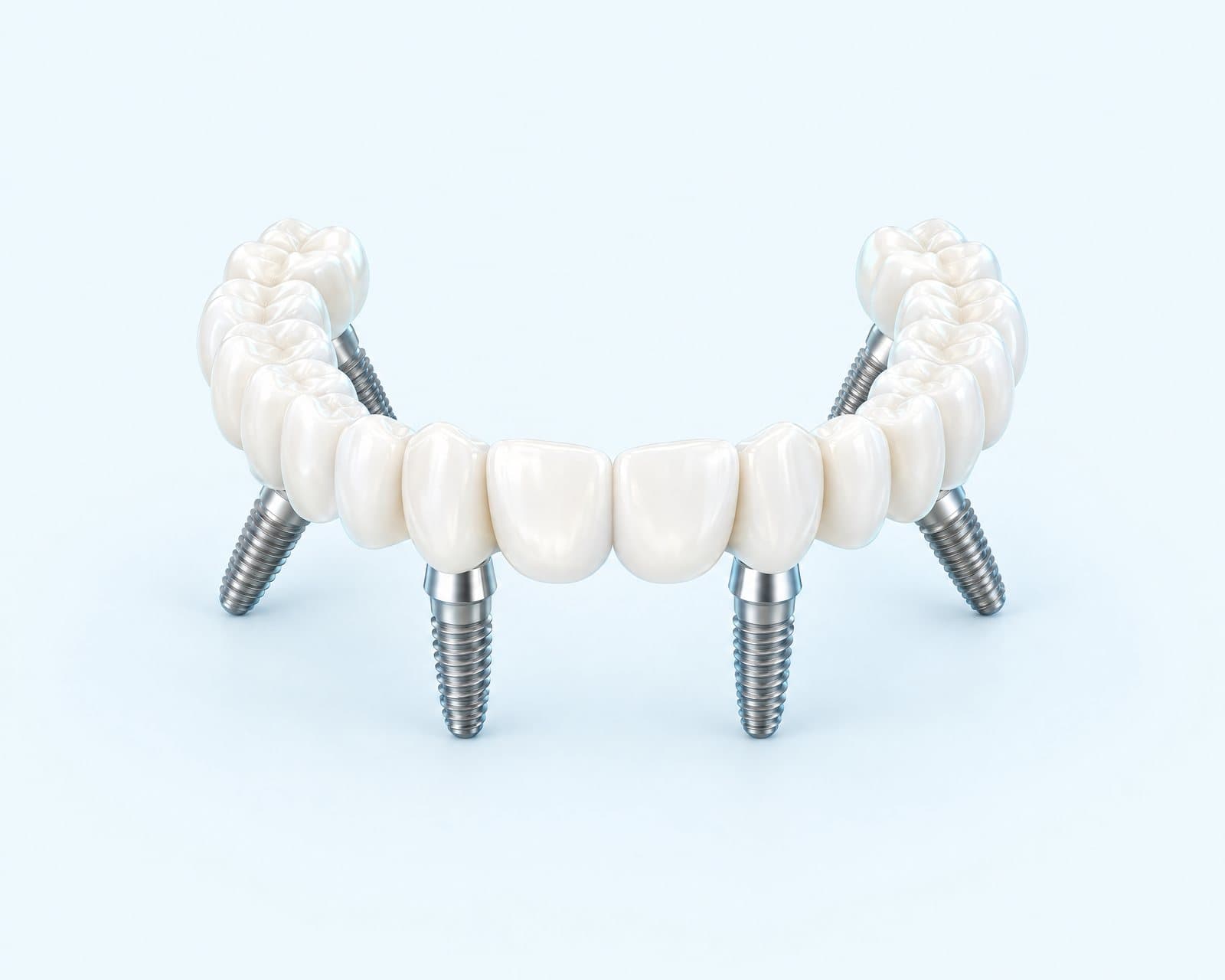
Full arch dental implants replace all the teeth in one jaw with a fixed bridge that stays in your mouth. Several implants, placed at intervals around the arch, act as the roots that hold the bridge steady. The bridge itself carries a full row of replacement teeth.
This is different from a removable snap-in implant dentures, which clicks onto implants but still comes out for cleaning. If you are still weighing a fixed arch against a removable denture, the implants vs dentures comparison covers stability, upkeep and cost side by side.
What are the fixed full-arch options?
Three approaches are common, and they differ mainly in implant number and whether grafting comes first. A four-implant protocol, called All-on-4®, angles the two back implants to use available bone. Other plans use five or more implants spread evenly around the arch, or place a dental bone graft first when the ridge needs building up.
Your bone width and height, your health and your goals decide which approach fits best. The table below summarizes the trade-offs.
| Approach | Number of implants | Often used when | Trade-offs |
|---|---|---|---|
| Four-implant protocol (All-on-4®) | Four implants, the back two angled | Bone is adequate without extra grafting | Fewer implants to place; the bridge design must suit four points of support |
| Five or more implants | Five to eight implants, evenly spaced | More support is wanted, or bone allows more implants | More implants to place and maintain, which can add cost |
| Grafting first, then implants | Decided after the graft has healed | The jaw lacks enough bone width or height for implants yet | Adds healing time before implants can be placed |
How is a full arch restoration planned, and who is a candidate?
Planning starts with an exam of your remaining teeth, gums, bite and bone, along with a 3D scan that maps the jaw in detail. Good candidates have enough bone to anchor several implants, or bone that can be built up first, and gums free of active infection. Health conditions and smoking are discussed, since they affect healing.
Some people can have failing teeth removed and same day dental implants placed, with temporary teeth attached that day, when the implants are stable enough. Others need a staged plan, wearing a temporary denture while the bone and implants heal before any fixed teeth go on.
What is recovery like after full arch treatment?
Swelling, bruising and soreness are common for the first several days after implant surgery, and a soft diet is usual for some weeks. Many people return to work within a few days, though those with same-day temporary teeth chew carefully at first. Numbness from the anesthetic wears off within hours.
The bone then heals around the implants over a few months before the final bridge is made. A temporary bridge or denture protects your bite and appearance during that time, and follow-up visits check healing and adjust the fit.
How do you clean under a fixed bridge?
A fixed full-arch bridge has small gaps beneath it that a toothbrush alone can't reach, so plaque and food can collect there. A water flosser, floss threaders or a small interdental brush clear these spaces daily. Cleaning under a fixed bridge takes a few extra minutes but protects the implants underneath.
Skipping this step lets plaque build up around the implants, which can lead to gum inflammation and, eventually, bone loss around an implant. Your hygienist can show you which tools fit your bridge best at a maintenance visit.
What are the risks and upkeep of a fixed arch?
Full arch implants are a well-established treatment, and major complications are uncommon. The surgery itself carries risks such as infection, an implant that doesn't bond with the bone and, in the lower jaw, nerve numbness that is usually temporary but not always.
Some people notice temporary changes in speech or the feel of their tongue against the new bridge at first, which usually settles as you adjust. Food can trap under the bridge until you learn the cleaning routine that works for you.
Longer term, the risks include peri-implant disease, an infection around an implant that can wear away supporting bone if plaque isn't controlled. The bridge material can chip, or a screw can loosen, and either needs a repair visit. Rarely, an implant does not stay firmly anchored and needs attention.
People sometimes call a fixed full-arch restoration "permanent dentures," but that nickname can mislead. The teeth stay fixed in your mouth day to day, yet they still need cleaning, check-ups and occasional repairs over the years.
What affects the cost of full arch dental implants?
The number of implants, whether grafting is needed first, and whether temporary teeth are placed the same day all affect the total cost. A four-implant plan often costs less than one using five or more implants, though your bone and goals decide which is right. Your exam sets the actual estimate.
- The number of implants and whether the back ones are angled
- Whether a bone graft is needed before implants can be placed
- Whether temporary teeth go on the same day or after a healing period
- The materials used for the fixed bridge
- Imaging used to plan implant position
- Future upkeep, including repairs and periodic replacement of the bridge
Care at Perio One
At Perio One, full arch treatment begins with a full examination and a 3D cone beam CT scan to map your bone before anything is decided. Dr. Randal Comeaux, DDS, Diplomate of the American Board of Periodontology, walks you through which fixed option fits your mouth and explains the findings in plain language.
We work closely with your general dentist, who typically designs and fits the final bridge, so both practices plan around the same imaging and timeline.
Referrals from dentists in and around Lafayette are welcome, and once your fixed teeth are in place, our periodontal maintenance program helps keep the implants and bridge healthy.
When to call us
- Most teeth in one arch are loose or failing
- A denture you cannot tolerate
- Fixed teeth that feel loose, cracked or sore
- Bleeding or swelling around the implants
- In the days after full arch surgery, call us right away for a fever, swelling that worsens or spreads, or bleeding that firm pressure doesn't stop. Severe symptoms, or trouble swallowing or breathing, need an emergency room or a call to 911.
Our periodontists, Dr. Randal Comeaux and Dr. Lauren Langlois, can talk through what you’re noticing.
Call to scheduleWhat to expect
- Examination and imaging
We check your remaining teeth, gums, bite and bone, and take a 3D scan to map the jaw.
- Choosing your approach
Dr. Comeaux explains which fixed option fits your bone and goals, including whether grafting comes first.
- Implant placement
Implants are placed during a procedure with local anesthetic, and some patients leave with temporary teeth the same day.
- Healing
The bone bonds to the implants over a few months while you wear temporary teeth.
- The final bridge
Once healing is confirmed, your dentist fits and attaches the final fixed bridge.
- Ongoing care
Daily cleaning under the bridge and regular maintenance visits protect the implants long term.
Common questions
How many implants for a full arch?
It varies. Some plans use four implants with the back two angled; others use five or more spread evenly around the arch, or add a bone graft first. Your bone, bite and health decide the number.
How long do full arch implants last?
The implants themselves often last many years with good care. The fixed bridge and any attachment screws can need repair or replacement over time, so plan on lasting a long while rather than never needing attention.
Do you floss full arch implants?
Not in the usual way, since the bridge is one connected piece. A water flosser, floss threaders or a small interdental brush clean the gaps beneath it daily, and your hygienist can show you the tools that fit your bridge.
Is All-on-6 better than All-on-4?
Not necessarily. More implants can add support, but four well-placed implants work well for many people with adequate bone. The right number depends on your bone, bite and what a 3D scan shows, not on a general rule.
What do full arch dental implants look like?
A full arch restoration looks like a complete row of teeth set into a bridge, shaped and colored to match a natural smile. It stays fixed in your mouth rather than clicking in and out like a denture.
Sources
- Cleveland Clinic: Implant-supported dentures
- American Academy of Periodontology: Dental implant procedures
- Cleveland Clinic: Dental implants
This page is general education, not a diagnosis. Your periodontist will recommend care after an examination.