
On this page
- What is ridge augmentation?
- Why does the jaw ridge become thin or short?
- How is a thin ridge rebuilt?
- Can the implant go in at the same time?
- What is recovery like after ridge augmentation?
- What are the risks of ridge augmentation?
- What affects the cost of ridge augmentation?
- Care at Perio One
- When to call us
- Common questions
At a glance
- A jaw ridge can lose width, height, or both after a tooth is missing for a while.
- Adding width to a ridge is more predictable than adding height, which tends to need more time and care.
- A particulate graft with a membrane suits many cases; a solid block graft suits larger defects.
- Some patients have the implant placed at the same time as the graft; others wait for the graft to heal first.
- Healing commonly takes four to 12 months, and the implant is sometimes placed partway through that time.
What is ridge augmentation?
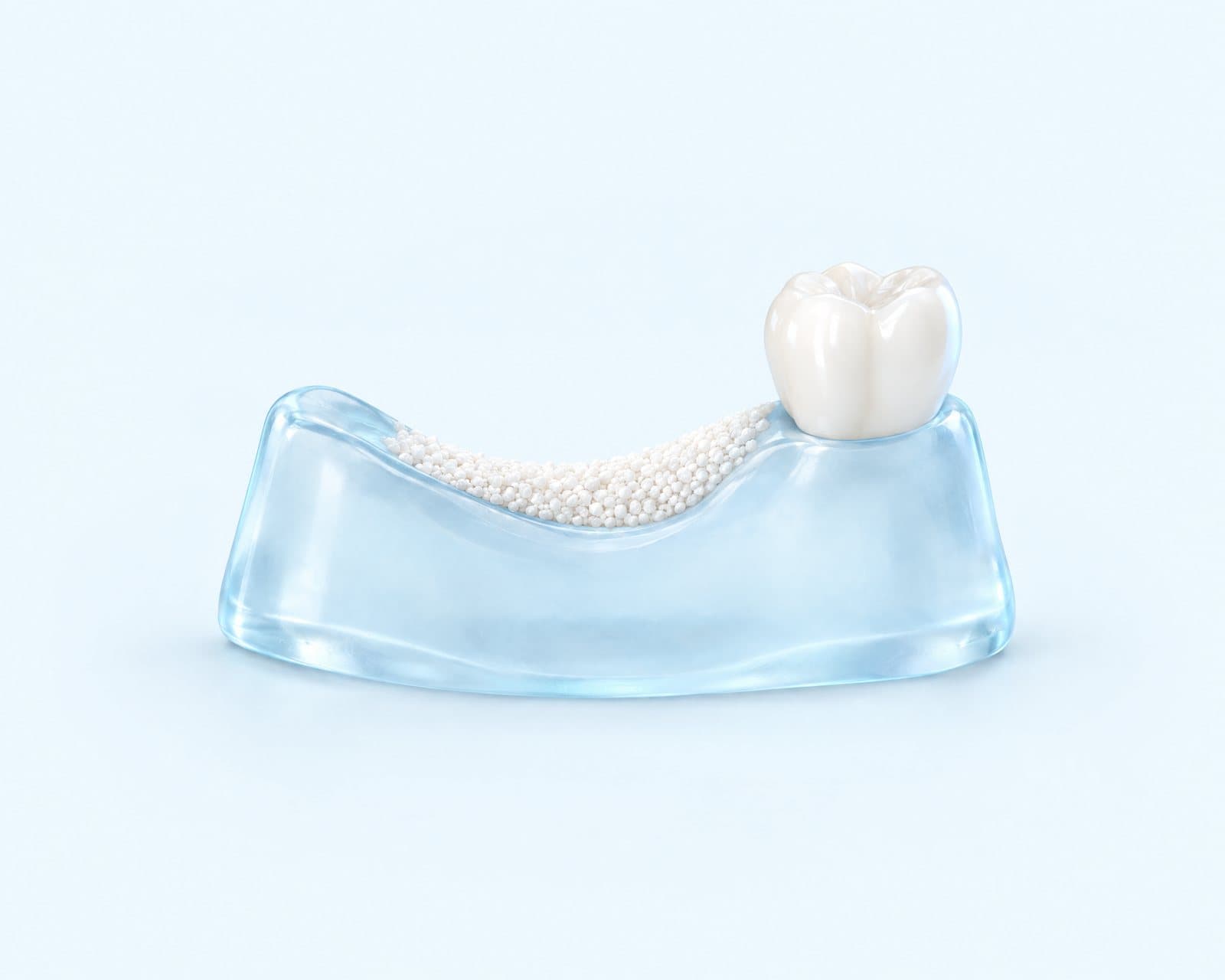
Ridge augmentation rebuilds the width, height, or shape of the bony ridge that once held a tooth root, so it can support a dental implant. It is a bone graft matched to the exact contour your ridge needs.
This differs from a graft placed right after a tooth comes out. Ridge augmentation is usually done later, once the ridge has already narrowed or sunk, though the two approaches share many of the same dental bone graft materials.
It is one specific kind of bone graft, focused on rebuilding the outer shape of the ridge rather than filling a fresh socket or lifting a sinus.
When the dent is only in the gum, not the bone underneath, soft-tissue ridge improvement may be enough instead of a bone graft.
Why does the jaw ridge become thin or short?
A jaw ridge thins mostly because bone needs a tooth root to stay dense, and that pressure disappears once a tooth is gone. Without it, the bone slowly resorbs from the sides and the top.
A ridge can also thin from long-term gum disease, an old injury, or years of wearing a denture that presses on the gum instead of the bone. Grafting a socket right after extraction, called bone graft after tooth extraction, can often limit this shrinkage from the start.
Adding height back to a ridge is generally harder and less predictable than adding width. New bone has to build upward against thinner gum tissue, rather than simply filling a wider space.
How is a thin ridge rebuilt?
A thin ridge is usually rebuilt one of two ways: a particulate graft covered with a protective membrane, or a solid block of bone shaped to fit the defect.
A particulate graft uses small pieces of graft material held in place under a membrane, which keeps soft tissue from growing into the space while new bone forms. It suits many width and moderate height defects.
A block graft uses one solid, shaped piece of bone, usually taken from another site or from processed donor bone, and is secured with small screws while it heals. A cone beam CT scan maps the ridge in three dimensions before either approach is planned.
| What differs | Particulate graft with a membrane | Block graft |
|---|---|---|
| Often used for | Width, and moderate height, defects | Larger defects needing more structure |
| A second site in the mouth | Not usually needed | Sometimes needed if bone is taken from you |
| Healing time | Commonly a few months to about a year | Often longer, given the size of the defect |
| Implant timing | Sometimes placed at the same time | Usually placed after the block has healed |
Can the implant go in at the same time?
Whether the implant goes in with the graft depends on how much rebuilding is needed and how stable the bone is right away. A small width graft sometimes allows the implant to be placed at the same visit.
Larger rebuilding, especially adding height, usually calls for the graft to heal on its own first. Placing the implant too soon in unstable bone risks the implant failing to bond properly.
Growth factors made from your own blood are sometimes added to the graft, and some studies suggest they may support soft-tissue healing, though the research on a bone-healing benefit is mixed.
What is recovery like after ridge augmentation?
Recovery after ridge augmentation is similar to other bone grafts: swelling and mild discomfort for the first several days, easing gradually over one to two weeks. Soft foods protect the area while it settles.
The graft or membrane needs time undisturbed beneath the gum, so avoid pressing on the area with your tongue, a denture, or a toothbrush until we say it is ready.
Full healing before an implant is placed commonly takes four to 12 months, sometimes with the implant added partway through if imaging shows the bone is ready.
What are the risks of ridge augmentation?
The graft or membrane can become exposed through the gum before it has fully healed, which sometimes needs a follow-up visit to manage. Infection and a graft that does not fully take are less common risks.
In the lower jaw, the nerve that supplies feeling to the lip and chin is checked carefully on the 3D scan beforehand. Working too close to it can cause temporary numbness that, rarely, does not fully fade.
Height gains are less predictable than width gains, so it is worth discussing realistic expectations with Dr. Comeaux before treatment begins.
What affects the cost of ridge augmentation?
Cost depends on the size of the defect, whether a particulate or block graft is used, and whether the implant is placed separately. Your exam and imaging set the specifics.
- Whether a particulate graft or a block graft is used
- The size of the area being rebuilt
- Whether growth factors are added
- Imaging used to plan the graft
- Whether the implant goes in right away or after the graft heals
Care at Perio One
At Perio One in Lafayette, ridge augmentation is usually planned with 3D cone beam CT imaging. This lets Dr. Randal Comeaux, DDS, Diplomate of the American Board of Periodontology, map your ridge before deciding on a graft.
Dr. Comeaux explains the findings and the graft options in plain language, including realistic expectations for width and height gains.
We coordinate with your general dentist, referrals are welcome, and your implant is followed in our periodontal maintenance program once it is placed.
When to call us
- You have been told there is not enough bone for a dental implant
- A dent in the gum where a tooth used to be that traps food
- After augmentation: graft or membrane showing through the gum
- Lip or chin numbness that does not fade
- After augmentation, call us right away about a fever, swelling that keeps spreading, or bleeding that firm pressure doesn't stop. Any severe symptom, or trouble swallowing or breathing, is a reason to go to an emergency room or call 911.
Our periodontists, Dr. Randal Comeaux and Dr. Lauren Langlois, can talk through what you’re noticing.
Call to scheduleCommon questions
What is ridge augmentation in dentistry?
It is a bone graft that rebuilds the width, height, or shape of a jaw ridge that has thinned, so the area can support a dental implant.
Is ridge augmentation the same as a bone graft?
It is one type of bone graft, focused specifically on rebuilding the outer shape of the ridge rather than filling a fresh extraction socket or lifting the sinus.
How long does ridge augmentation take to heal?
Healing commonly takes four to 12 months, depending on the size of the defect and whether width, height, or both are being rebuilt.
Is ridge augmentation painful?
The procedure itself is done with local anesthetic, and most people describe pressure rather than pain. Afterward, mild soreness and swelling for several days are common.
What happens if you don't have enough bone for dental implants?
Without enough bone, an implant may not sit securely or could fail over time. Ridge augmentation adds the missing width or height so the implant has a stable base.
How much bone does ridge augmentation add?
The amount depends entirely on your starting ridge and the graft technique used. Imaging before and after treatment shows the change for your specific case.
Sources
- American Academy of Periodontology: Ridge modification
- Cleveland Clinic: Dental bone graft
- American Academy of Periodontology: Cosmetic procedures
This page is general education, not a diagnosis. Your periodontist will recommend care after an examination.